
Transcript:
In this edition of Knyzka Corner, we will be discussing Diana Stevan’s novel, Sunflowers Under Fire.
Sunflowers Under Fire tells the epic story of Diana Stevan’s grandmother who lived in Ukraine during the years 1915 to 1928. Enduring World War I, a civil war, and great personal hardship, Lukia not only survives, but becomes a resilient heroine. She “asked nothing of life except the means to feed and shelter her growing family.” (p. 1)
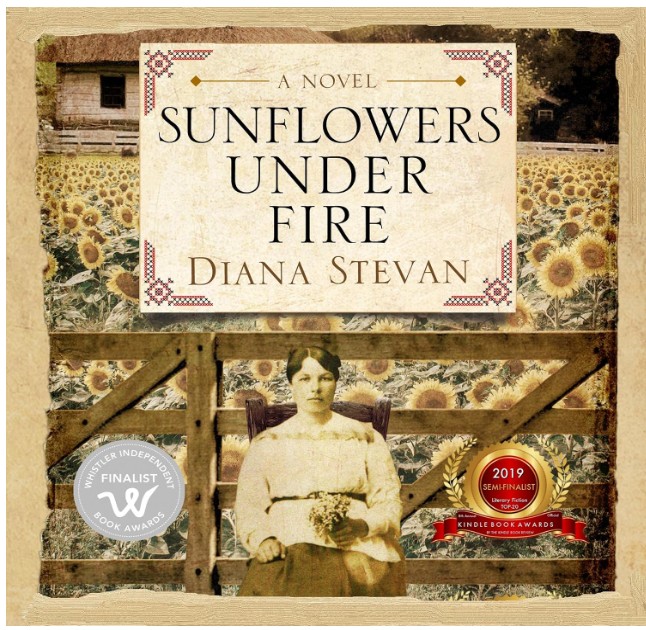 As the novel begins, it is August 5, 1915, and Lukia Mazurets delivers her eighth child alone at her farmhouse in the village of Kivertsi in Volhynia. She names the new baby, Eudokia, and prays that she will be strong. Lukia has already lost two babies to illness. When her husband Gregory returns, he announces that he has joined the Tsar’s army to fight for his native Ukraine. Lukia is appalled and angry as he leaves her with five children and a newborn. She tells Gregory that the Tsar, “needs Ukrainians to do his dirty work. Well, I spit on the Tsar. We’re nothing to him.” (p. 5) As the war between Austria and Russia escalates, the villagers of Kivertsi are sent away to safety. At first, Lukia and her six children are supposed to go to Siberia, but through Gregory’s intervention, they are sent to a much warmer refugee camp in the Caucasus. “All around her, on the train and in the countryside, there were thousands of families like hers, headed by women traveling to places far from home and far from the men they loved. What was to become of them all?” (p. 43)
Lukia and her family spend a difficult few years in the Caucasus refugee camp. She survives by bartering and using her sewing skills to purchase extra food. Her resilience is severely tested as her family survives hunger, grave illness, and social isolation. When the war ends, the family comes back to a destroyed farm. Her husband returns, but suffers from post-traumatic stress syndrome. Although the family slowly rebuilds, their losses multiply with tragic deaths, unbearable losses, and impossible choices.
Readers will learn a great deal about Ukrainian culture and history in Sunflowers Under Fire. There are lengthy descriptions of Ukrainian traditions at Easter and Christmas, as well as details about marriage ceremonies, Ukrainian folk dancing, and songs. Lukia finds herself embroiled in major historical events. The Tsar’s daughter, Olga Nikolaevna, appears as a nurse who saves Eudokia’s life. Shortly afterwards, Lukia learns that the entire family of the Tsar has been massacred by the Bolsheviks. Lukia is approached to become a member of the Bolsheviks at one point, but she refuses. Her family becomes involved in the short-lived declaration of Ukrainian independence. She is also part of the Ukrainian emigration to Canada. All of these events make her a participant and an observer of the difficult history of Ukraine in the years 1915 to 1928.
Sunflowers Under Fire is based on the life of Diana Stevan’s grandmother in Ukraine. She dedicates the book to, “My mother, Eudokia Klewchuk (nee Mazurec) a natural-born storyteller.”
Lukia’s story is an unforgettable historical saga about a strong and resourceful woman. Her resilience and courage in the face of incredible obstacles shows the strength of her character. She keeps going no matter what she faces: typhus, death, exile, hunger, and loneliness. It is a book which is not easy to read at times, but it will definitely live in the reader’s imagination long after the last page!
Diana Stevan has worked as a family therapist, professional actor and freelance writer-broadcaster for the CBC. She has written two novels: A Cry From The Deep and The Rubber Fence. She has two daughters and lives with her husband in West Vancouver, British Columbia.
Sunflowers Under Fire is available at Chapters/Indigo and Amazon.
–Reviewed by Myra Junyk
Editor’s note: This review aired in 2019. Since then, Diana went on to write two sequels to this book, creating a trilogy of a fascinating family saga. All her books are available from “bricks and mortar” bookstores as well as from all online booksellers. But if you click on a link on this website that takes you to Amazon, your purchase could generate a (small) commission for Nash Holos. Which will get a large multinational corporation to share a bit of its profits and help support Nash Holos on the air and online. Thank you for listening, and for your support!