
In this edition of Knyzka Corner, we will be discussing Serhiy Zhadan’s play A Harvest Truce.
A Harvest Truce is a tragicomedy about the dignity of the human spirit. The play takes place in war-ravaged Eastern Ukraine where ordinary people have been living with Russian incursions since 2014. The “harvest truce” allows farmers to harvest their crops. Two brothers, Anton and Tolik, must deal with the death and burial of their mother, despite the fact that they have no power or water because their house is on the front lines of the war. “Our Memory could fill the chilled, abandoned apartments, it could heal an entire generation’s despair, it could repair the fatigue of so many strong, grown people. We have enough memory to love you, but too little to bring you back.” (p.3)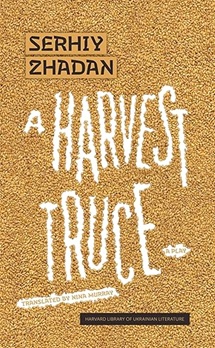
Anton, the older brother, returns to his childhood home to find his younger brother Tolik grieving for their mother. The two brothers have a complicated relationship. Tolik lived with his mother, but they too had a difficult relationship and barely spoke to each other. Despite the family dynamics, the mother needs to be buried. However, the war with Russia is literally on their doorstep. Anton’s car has been abandoned because the local bridge is destroyed, and as a result, he has come across the river on a rubber boat. They try to arrange burial services, but the war makes it virtually impossible to do so. “We can’t get her across pontoons, right? And we can’t just leave her here either, gotta bury her properly, with paperwork and all, right? (p. 15)
As they struggle to deal with the grief and the reality of their mother’s death, neighbours start to appear. First, a group of three women come to prepare the mother’s body for burial. However, Tolik fears that the women are Russian spies who will betray them. He tells Anton that the oldest woman, Aunt Shura, “Goes around to sniff out who’s on whose side. She’ll rat us out.” (p. 59) Then, Kolya and his pregnant wife Mashka appear as they search for a way to get to a hospital. Their fields have been set on fire by the Russians. All of these people grieve for Anton and Tolik’s mother, who was a part of their community. Kolya tells the brothers, “Sure, we’ll bury her. We’ll help – what else are neighbors for?” (p. 110) However, all the characters are overwhelmed by the horrors of war and their fear of the future. “We’re just sitting here, like mice in a trap.” (p. 120)
Zhadan’s play is difficult to read, but very enlightening. It is filled with despair and hopelessness, but it also shows the remarkable resilience of the Ukrainian people. Despite horrific circumstances, families continue to navigate life and death. Traditions and rituals must be followed. Anton tells his brother, “Don’t worry bro. We’ll figure it out. Family is sacred,” (p. 16) Neighbours continue to try to help each other despite their diminished circumstances.
This powerful play will give readers a window into the anguish felt by the ordinary people of Eastern Ukraine, as their homes and livelihoods are systematically obliterated by Russian invaders and their collaborators. At times, the play echoes Samuel Beckett’s Waiting for Godot as the characters navigate an absurd world seemingly without hope. Although the play presents tragic circumstances, there are also comic interactions between various characters showing the resilient survival instinct of the Ukrainian people. When Anton tries to take a shower, he soon realizes there is no water to be found!
Readers who want to understand the impact of the Russian incursions into Eastern Ukraine will definitely want to read this play. Zhadan’s powerful voice reveals the very difficult realities of life. Rinat, the postman who has no mail to deliver, tells the group, “What rules are you talking about? Everyone’s surviving the way they can. There’s just too much death around us.” (p. 164). Aunt Shura, however, looks to the future, “All of this will end, eventually. Life will go on. Everyone has to go on living somehow…” (p. 165)
Serhiy Zhadan is an award-winning Ukrainian poet, translator, and political activist who was born in Starobilsk, Luhansk Region. He studied Ukrainian and German literature in Kharkiv where he lives and teaches. He has won several literary awards including the BBC Ukraine Book of the Year, the Joseph Conrad-Korzeniowski Literary Award, the Brücke Berlin Prize, the Hubert Burda Prize, the Derek Walcott Prize for Poetry, as well as Book of the Year Ukraine in 2022. His works include Depeche Mode (2004), Voroshilovgrad (2010), and The Orphanage (2017). The Harvest Truce was produced by the University of Alberta Studio Theatre in September 2025.
Nina Murray is an award-winning translator of Ukrainian literature. She has translated works by Stanislav Aseyev and Lesia Ukrainka, as well as others. Murray was born in Lviv and graduated from the Ivan Franko National University of Lviv with a Master’s degree in linguistics and creative writing. Since 2011, she has worked as an American diplomat. She served in Kyiv in 2023 and later in Washington D.C. She has subsequently retired and works as Connect Program Director with Razom for Ukraine, a humanitarian and advocacy nonprofit, in Washington, D.C.
A Harvest Truce is available at Chapters/Indigo and Amazon [and directly from HURI. ed].
Zhadan, Serhiy. Translated by Nina Murray.
A HARVEST TRUCE.
Harvard Ukraine Research Institute, 2024, 187 p.
ISBN 9780674292017
Available at Chapters/Indigo and Amazon
Reviewed by Myra Junyk